Molecular Sieve 4A
Sodium-A zeolite with a 4 Å pore — the general-purpose dryer for natural gas, compressed air and liquids, with the highest water capacity of the A-type sieves.
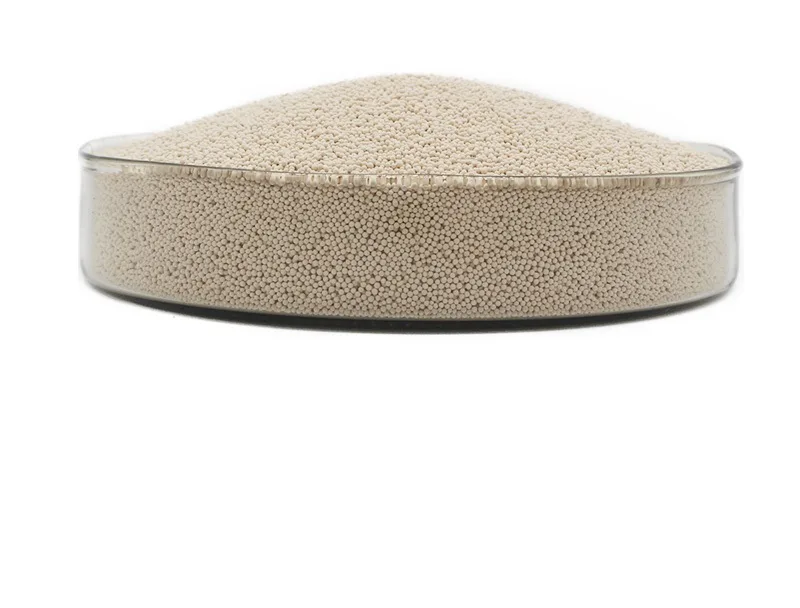
Overview
Type 4A is the sodium form of the A zeolite, with an effective pore opening of about 4 ångströms. It adsorbs water, carbon dioxide, hydrogen sulfide and methanol, and still excludes branched and cyclic hydrocarbons, which makes it the workhorse for drying gases and liquids that carry small polar contaminants.
Because it holds more water per kilogram than 3A and regenerates at standard dryer temperatures, 4A is the default first choice for natural-gas dehydration ahead of cryogenic processing, for instrument-air dryers, and as a static desiccant. Where the stream contains ammonia in quantity, or where CO₂ removal is the primary target, 13X is the better tool — the FAQ below covers the boundary.
Applications
- Natural-gas dehydration ahead of LNG and cryogenic fractionation
- Compressed-air and instrument-air drying to sub-ppm moisture
- CO₂ and H₂S co-removal from hydrocarbon gas streams
- Refrigerant and insulating-glass drying (general grade)
- Solvent and liquid hydrocarbon drying
- Static desiccant duty in packaging and sealed enclosures
Specifications
| Property | Molecular Sieve 4A |
|---|---|
| Crystal type | Sodium-A (NaA) |
| Bead sizes | 1.5–3.0 · 3.0–5.0 mm (pellets on request) |
| Equilibrium water capacity | ≥ 22.0 wt% (25 °C, 50% RH) |
| Crush strength | ≥ 60 N (1.5–3.0 mm) · ≥ 130 N (3.0–5.0 mm) |
| Bulk density | 0.70–0.78 g/cm³ |
| Attrition loss | ≤ 0.10 wt% |
| Package moisture | ≤ 1.5 wt% |
Typical values for orientation. The grade-specific datasheet governs any quotation — request it with your inquiry.
Packing, documents & delivery
Packing
25 kg bags, steel drums or bulk bags — the format is confirmed in the quotation and matched to your unloading and storage.
Documents
Datasheet before order, batch COA with shipment, packing list and commercial invoice with every consignment.
Delivery terms
Prices are quoted EXW Zibo. Ocean freight is calculated for your order and destination port at the time of quotation.
Frequently asked
4A or a TEG glycol unit for natural gas?
Glycol is economical at large throughputs with moderate dew-point targets. A 4A bed reaches far lower outlet water content (sub-ppm), needs no glycol make-up or emissions handling, and protects cryogenic equipment from freeze-ups. Many plants run 4A as the polishing stage behind a bulk-removal step.
What dew point can 4A reach?
In a properly designed heated or heatless dryer, 4A routinely delivers pressure dew points of −60 °C and below. The limit is set by regeneration quality and cycle design rather than by the sieve itself — share your dryer data and we will sanity-check the expected outlet.
When does 4A fail and 13X take over?
Two cases: sustained ammonia service, which degrades A-type crystals, and duties where CO₂ capacity is the sizing constraint — 13X holds roughly twice the CO₂. If either applies, we will say so and quote 13X instead.
Technical articles
- Molecular Sieve 4A for Natural Gas Pipeline Dew Point Control: Joule-Thomson Cooling, Hydrate Prevention, and ISO 18453 Compliance
- Molecular Sieve 4A vs TEG (Triethylene Glycol) Dehydration for Natural Gas — 10 Year TCO Comparison | AluminaWorld
- Molecular Sieve 4A for Detergent Builder: How Zeolite 4A Replaced STPP in Powder Detergent Formulations
Request a quotation
To confirm the right grade, it helps to send: gas or liquid composition, flow rate, inlet water content, target dew point, vessel dimensions and cycle times.
Tell us your process.
Get a reply from an engineer.
Send your application, current media and quantity. We will confirm the right grade, share the datasheet, and quote a clear EXW price — no obligation.